Understanding Your Tax Code
England Tax Calculator 2026/27
Calculate 2026/27 Income Tax and employee National Insurance for an employee taxed under England’s main PAYE bands.Annual gross salaryRegionEngland / Wales / Northern IrelandScotland
Calculate
Result—
Result—
Result—
Result—
The figures on England Tax Calculator 2026/27 use 2026/27 rules. Its purpose is England employment tax, not a forensic reconstruction of every payroll event. In practice, the main breakpoints are the higher-rate band, the £100,000 allowance taper and the additional-rate threshold. and period-specific PAYE can make an actual deduction differ from this annualised result.
How to Use the England Tax Calculator 2026/27
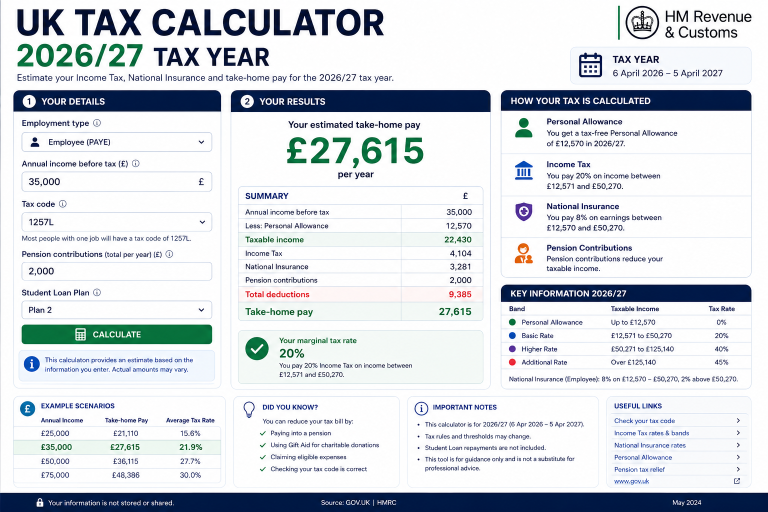
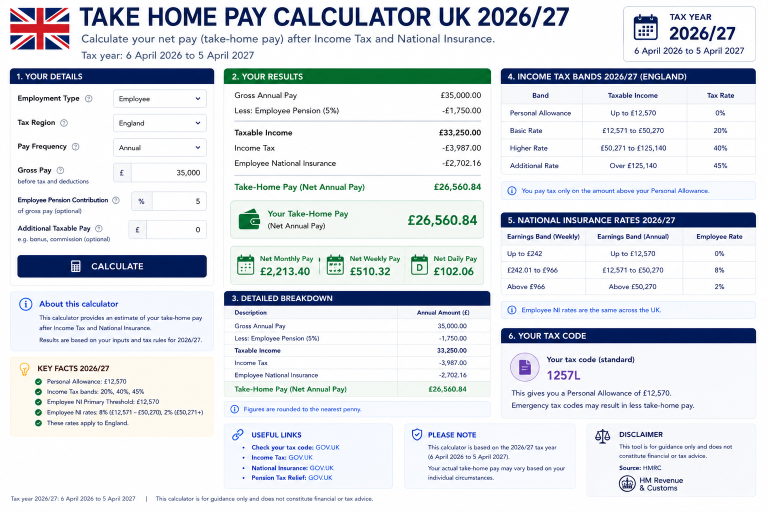
The standard Personal Allowance and 20%, 40% and 45% non-savings rates form the base annual estimate. The England calculation is the reference point many UK salary comparisons use, but it still needs the allowance taper above £100,000 to avoid understating tax for high earners.
Personal Allowance tapering above £100,000 is built into the calculator. The page does not model special tax-code adjustments unless the user moves to the tax-code tool.
2026/27 Personal Allowance
An allowance check comes before the band calculation in this model. A standard taxpayer begins with £12,570 for 2026/27, but the amount is tapered once adjusted net income passes £100,000. The withdrawal can materially change the result where the main breakpoints are the higher-rate band, the £100,000 allowance taper and the additional-rate threshold..
Income Tax Rates Used in the Model
For rest-of-UK employment-income comparisons on England Tax Calculator 2026/27, taxable income after allowances is charged at 20% through the £37,700 basic band, 40% from £37,701 to £125,140, and 45% above that. The calculator applies those slices progressively rather than taxing the full salary at the highest rate reached. For this calculator, the next step is not to apply every tax rule on the site. It is to connect the figure with England employment tax, using the main 20%, 40% and 45% rate ladder. That narrower scope is intentional for employees whose taxpayer residence is in England.
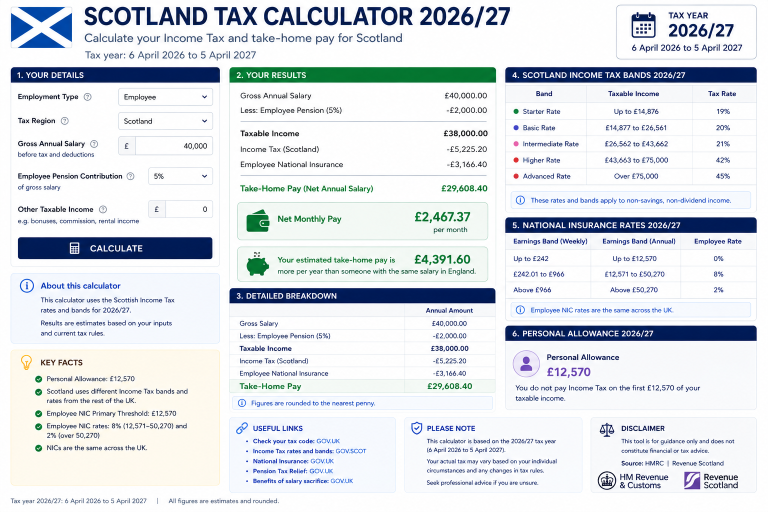
Where a regional comparison is useful for England Tax Calculator 2026/27, Scotland is treated as a distinct employment-income system rather than a minor adjustment. The main breakpoints are the higher-rate band, the £100,000 allowance taper and the additional-rate threshold. Savings and dividend taxation are separate questions, so they are not folded into this salary comparison.
National Insurance and Other Deductions
Employee NI uses a different threshold system from Income Tax. When England Tax Calculator 2026/27 needs a net-salary figure, it applies the 2026/27 category-A-style 8% main rate and 2% upper rate on annualised earnings. When NI is irrelevant to England employment tax, it is left out rather than blended into the result.
Education-loan deductions are shown as their own payroll item because England employment tax is a different calculation. Current annual thresholds are £26,900, £29,385, £33,795 and £25,000 for Plans 1, 2, 4 and 5 respectively; postgraduate remains £21,000 with a 6% rate. The reason it appears on England Tax Calculator 2026/27 is page-specific: England employment tax can be misunderstood if the main 20%, 40% and 45% rate ladder is left implicit. The wording here is aimed at employees whose taxpayer residence is in England and the result should be read on that basis.
Who Should Use the England Tax Calculator 2026/27
An England-based employee wanting a current-year salary estimate can use this page without sorting through Scottish band tables that do not apply.
The calculation centres on main UK rates plus the allowance taper. The main breakpoints are the higher-rate band, the £100,000 allowance taper and the additional-rate threshold. Keeping those drivers explicit makes it possible to rerun the same scenario after a pay rise, code change or new tax year without guessing which assumption moved.
Use the result to understand England employment tax, then move to a specialist page if another income source or deduction becomes material. A page that tries to solve salary, dividends, capital gains, benefits, pensions and multiple jobs in one default calculation would hide more assumptions than it explains. BritTaxCalc treats this differently on England Tax Calculator 2026/27 because the core output is England employment tax. By focusing on the main 20%, 40% and 45% rate ladder, the page avoids suggesting that the same rule has identical importance on every calculator.
Worked Examples for England Tax Calculator 2026/27
- Example 1: enter £30,100 annual income and review the allowance, tax and any relevant payroll deduction separately. Changing only one input at a time makes it easier to see which threshold changes the result.
- Example 2: enter £37,100 annual income and review the allowance, tax and any relevant payroll deduction separately. Changing only one input at a time makes it easier to see which threshold changes the result.
- Example 3: enter £44,100 annual income and review the allowance, tax and any relevant payroll deduction separately. Changing only one input at a time makes it easier to see which threshold changes the result.
- Example 4: enter £51,100 annual income and review the allowance, tax and any relevant payroll deduction separately. Changing only one input at a time makes it easier to see which threshold changes the result.
- Example 5: enter £58,100 annual income and review the allowance, tax and any relevant payroll deduction separately. Changing only one input at a time makes it easier to see which threshold changes the result.
- Example 6: enter £65,100 annual income and review the allowance, tax and any relevant payroll deduction separately. Changing only one input at a time makes it easier to see which threshold changes the result.
- Example 7: enter £72,100 annual income and review the allowance, tax and any relevant payroll deduction separately. Changing only one input at a time makes it easier to see which threshold changes the result.
- Example 8: enter £79,100 annual income and review the allowance, tax and any relevant payroll deduction separately. Changing only one input at a time makes it easier to see which threshold changes the result.
Common Mistakes to Avoid
- Using 2025/26 thresholds on a page labelled 2026/27.
- Applying the highest marginal rate reached to the whole salary.
- Forgetting the Personal Allowance taper above £100,000 where it applies.
- Mixing Scottish employment-income rates with rest-of-UK bands.
- Treating National Insurance or student loans as if they were part of Income Tax.
- Assuming an annual estimate must equal every monthly PAYE deduction.
Related BritTaxCalc Calculators
Open the focused 2026/27 calculator.
Open the focused 2026/27 calculator.
Open the focused 2026/27 calculator.
Open the focused 2026/27 calculator.
Open the focused 2026/27 calculator.
Open the focused 2026/27 calculator.
Open the focused 2026/27 calculator.
Open the focused 2026/27 calculator.
England Tax Calculator 2026/27 FAQs
Which tax year does this page use?
2026/27, running from 6 April 2026 to 5 April 2027.Is the result an HMRC calculation?
No. It is an independent planning estimate using published rules and stated assumptions.Which tax year is this calculator for?
The calculation is labelled for 6 April 2026 to 5 April 2027.Can actual payroll differ?
Yes. Pay frequency, cumulative PAYE, tax codes, benefits and other deductions can change a real payslip.