UK Tax Calculator 2026/27
Estimate Income Tax, PAYE, employee National Insurance, student-loan deductions and take-home pay using current 2026/27 UK rules, with separate Scottish employment-income bands and specialist calculators for tax codes, dividends, CGT and pensions.
2026/27 tax yearEngland · Wales · NIScotlandPAYE + NIStudent loans
2026/27 Take-Home Pay Estimate
Annual gross salaryTax regionEngland / Wales / Northern IrelandScotlandPension salary sacrifice %Student loanNonePlan 1Plan 2Plan 4Plan 5Postgraduate only
Calculate Take-Home Pay
Income Tax—
Employee NI—
Student Loan—
Net / Year—
Annual planning estimate. PAYE payroll can differ because of tax codes, pay frequency, cumulative treatment, benefits and other deductions.
Popular UK Tax Calculators
Use the specialist tool that matches the tax question instead of forcing every calculation through one generic result.
💷
Take-Home Pay
Estimate annual and monthly net salary.
🧾
PAYE
See Income Tax, NI and payroll deductions.
🏴
Scotland
Use the separate Scottish income bands.
🔢
Tax Code
Explain common PAYE tax codes.
🎓
Student Loan
Plan 1, 2, 4, 5 and postgraduate.
📈
Dividend Tax
Use the 2026/27 dividend allowance and rates.
🏠
Capital Gains
Model the £3,000 annual exempt amount.
🏦
Pension Relief
Estimate grossed-up pension tax relief.
UK Tax Calculator 2026/27: What This Site Is Built to Calculate
BritTaxCalc is designed around the tax questions people actually ask when looking at a payslip, job offer, pension decision or investment gain. The core calculation starts with gross income, the Personal Allowance, Income Tax bands and National Insurance, then adds deductions such as student loans where the user chooses them. Separate tools handle dividend tax, Capital Gains Tax, tax codes and pension relief because those calculations have different rules.
For the 2026/27 tax year, the standard Personal Allowance remains £12,570. For taxpayers in England, Wales and Northern Ireland, taxable non-savings income is charged at 20% within the basic-rate band, 40% in the higher-rate band and 45% above the additional-rate threshold. Scottish non-savings income uses six bands instead, so the region selector is not cosmetic: it can materially change the take-home result.
The £100,000 Personal Allowance Taper
One of the most important thresholds in UK salary calculations is £100,000 of adjusted net income. Above that point, the Personal Allowance is reduced by £1 for every £2 of income over £100,000. The standard allowance is completely removed once adjusted net income reaches £125,140.
That taper creates a high effective marginal rate across the withdrawal zone because extra income is taxed while also taking away tax-free allowance. A salary-only calculator can show the mechanics, but adjusted net income can also be affected by items such as pension contributions and Gift Aid. This is why pension and £100k tax-trap tools should sit alongside the general salary calculator rather than being reduced to a single headline percentage.
England, Wales and Northern Ireland Income Tax for 2026/27
For employment income outside Scotland, the 2026/27 PAYE bands continue to use a standard £12,570 Personal Allowance where the taxpayer is entitled to it. After allowances, the basic-rate band is £37,700 at 20%, the higher-rate band runs from £37,701 to £125,140 at 40%, and taxable income above that level is charged at 45%.
Those band figures are taxable-income bands, not simply salary cut-offs in every case. A person with a full Personal Allowance reaches the higher-rate region at a different gross salary from someone whose allowance is tapered. Tax codes, benefits and other income can also change PAYE deductions, so the annual calculator should be treated as a transparent estimate rather than an exact reproduction of every payroll run.
Scotland Uses Different Tax Bands
Scottish taxpayers have separate rates for non-savings, non-dividend income. For 2026/27 the published Scottish structure has a 19% starter rate, 20% basic rate, 21% intermediate rate, 42% higher rate, 45% advanced rate and 48% top rate. The lower thresholds were changed for the new year while the higher, advanced and top thresholds were maintained.
The UK-wide Personal Allowance still applies, including the taper above £100,000. Savings and dividend taxation remains reserved, so a Scottish taxpayer can face Scottish rates on salary while dividends use the UK-wide dividend rates. BritTaxCalc therefore separates employment-income region rules from dividend and capital-gains tools.
National Insurance in 2026/27
Most employees in category A pay Class 1 National Insurance at 8% between the Primary Threshold and Upper Earnings Limit, then 2% above the upper limit. GOV.UK publishes weekly and monthly thresholds for payroll, while annual salary calculators commonly use annualised equivalents for planning.
National Insurance is calculated separately from Income Tax. That matters when comparing salary sacrifice, bonuses and pay rises because reducing contractual cash salary through an eligible pension salary-sacrifice arrangement can affect both Income Tax and employee National Insurance. The exact payroll outcome can depend on employer setup and pay frequency.
Student Loan Repayment Thresholds for 2026/27
From 6 April 2026, the annual repayment thresholds are £26,900 for Plan 1, £29,385 for Plan 2, £33,795 for Plan 4 and £25,000 for Plan 5. Those undergraduate plan repayments remain 9% of earnings above the relevant threshold. The postgraduate threshold remains £21,000 and the deduction rate remains 6%.
PAYE student-loan deductions are based on earnings within the pay period rather than a final annual tax calculation. The student-loan page therefore shows an annualised planning figure and clearly labels it as such. Someone with irregular bonuses or changing hours can see different deductions across individual payslips even when the annual salary looks straightforward.
Tax Codes: Why 1257L Is Only the Starting Point
A standard 1257L code usually reflects the standard £12,570 Personal Allowance, but tax codes can change when HMRC needs to collect tax on benefits, untaxed income or an earlier underpayment. BR, D0 and D1 apply a single rate to relevant employment income, while 0T gives no Personal Allowance. Emergency versions such as 1257L W1, M1 or X operate on a non-cumulative basis.
The code checker on BritTaxCalc is intended to explain the structure and model common annual effects, not to replace an HMRC tax-code notice. PAYE is cumulative in many normal cases, and payroll software uses period-specific tables. If a code looks wrong, the correct next step is to compare it with the HMRC record rather than manually editing a payslip.
Dividend Tax Changed for 2026/27
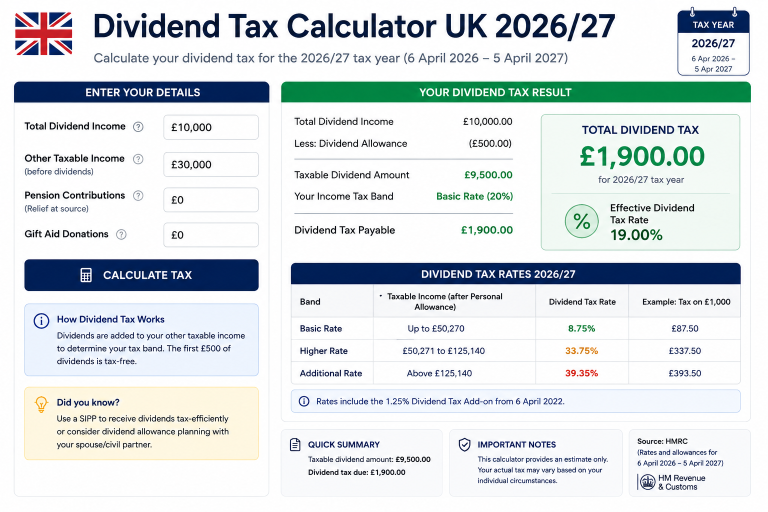
The dividend allowance remains £500 for 2026/27. Dividend rates above that allowance are now 10.75% for the ordinary rate and 35.75% for the upper rate, while the additional dividend rate remains 39.35%. The 2026 increase makes it more important to use the correct tax year when comparing salary and dividend outcomes.
Dividend tax is stacked after other income for band purposes. A simple dividend calculator should therefore ask for other taxable income rather than applying one dividend rate to the entire distribution. Dividends inside an ISA are outside this calculation, and company-owner planning can involve corporation tax and other rules that require a wider model.
Capital Gains Tax for 2026/27
For most individuals, the Capital Gains Tax annual exempt amount is £3,000 in 2026/27. General individual CGT rates are 18% and 24%. A basic-rate taxpayer can have some taxable gains charged at 18% until the remaining basic-rate band is used, with the balance charged at 24%. Higher and additional rate taxpayers will normally pay 24% on gains in this general calculation.
The gain is not simply the sale proceeds. The starting point is normally disposal proceeds less allowable acquisition and disposal costs, enhancement expenditure and applicable losses. Special reliefs and rules can change the result, so the calculator focuses on the mainstream individual case and links to official guidance for disposals requiring more detailed treatment.
Pension Tax Relief and Salary Sacrifice
Registered pension contributions can receive tax relief, but the mechanism matters. Relief-at-source schemes generally add basic-rate relief to the member’s net contribution, with higher-rate taxpayers potentially claiming additional relief. Net-pay arrangements deduct contributions before Income Tax, while salary sacrifice replaces part of future cash salary with an employer pension contribution.
The standard pension annual allowance is £60,000 for 2026/27, subject to earnings, tapering and other restrictions. A salary-sacrifice estimate should also consider National Insurance, because a successful pension salary sacrifice reduces contractual cash pay for tax and NIC purposes. Employer policies can determine whether any employer NIC saving is shared.
PAYE Is a Payroll System, Not a Separate Tax
PAYE stands for Pay As You Earn. It is the mechanism employers use to deduct Income Tax from employment pay. The underlying Income Tax liability still depends on allowances, taxable income and tax bands, while the tax code tells payroll how much allowance or special treatment to apply during the year.
An annual PAYE calculator can estimate the likely tax on a stable salary, but individual monthly or weekly deductions may vary because PAYE is often cumulative. Starting a job mid-year, receiving a bonus, changing tax code or moving onto an emergency code can produce a payslip deduction that does not equal one-twelfth of the annual estimate.
Gross Pay, Taxable Pay and Take-Home Pay
Gross salary is not always the same as taxable pay. Salary sacrifice can reduce contractual cash salary, some benefits add taxable value, and certain pension arrangements change the amount subject to Income Tax without changing headline remuneration in the same way. Take-home pay is the cash left after PAYE tax, employee National Insurance, student loans and other payroll deductions.
A useful calculator shows those components separately. Showing only a single net figure makes it difficult to understand why a job-offer comparison changed, whether a pension election caused the difference, or whether the result is driven by Income Tax rather than National Insurance.
Tax Refund Estimates Need the Tax Already Paid
A tax refund cannot be estimated from salary alone. The calculator needs the tax actually deducted and an estimate of the correct annual liability. If tax paid is higher than estimated liability, the difference is a potential overpayment; if it is lower, the result points the other way.
Real refunds can involve multiple employments, taxable benefits, pension relief, savings, prior-year adjustments or HMRC reconciliations. BritTaxCalc keeps the refund tool deliberately transparent: it compares paid tax with an estimated liability and explains that the final repayment is determined by HMRC.
Why Current-Year Tax Data Needs Visible Dates
Tax calculators are unusually sensitive to stale thresholds. A page that still uses 2025/26 student-loan limits or old dividend rates can look polished while producing the wrong result. Every current-year page should therefore state 2026/27 clearly and link to official GOV.UK or Scottish Government references.
Historical pages should behave differently. Once a tax year is closed, its thresholds should be frozen rather than silently updated to the newest rules. That makes older salary comparisons reproducible and prevents a user researching a previous payslip from seeing current-year bands applied to old income.
How to Use BritTaxCalc for a Job Offer
Start with the annual gross salary and region, then add pension salary sacrifice and the relevant student-loan plan. Compare annual net pay first, then monthly net pay. If the offer includes a bonus, company car, taxable benefits or unusual pension terms, use the specialist calculators rather than assuming the headline salary contains every tax consequence.
A stronger comparison also looks beyond tax. Pension employer contributions, holiday, working hours, bonus certainty and commuting cost can outweigh a small difference in monthly net pay. The tax calculator answers the payroll side of the decision, not the full value of the employment package.
2026/27 Core Tax Reference Table
| Item | 2026/27 figure | Use in calculators |
|---|---|---|
| Standard Personal Allowance | £12,570 | Tapers by £1 per £2 above £100,000 adjusted net income. |
| RUK basic / higher / additional | 20% / 40% / 45% | England, Wales and Northern Ireland non-savings income. |
| Employee NI category A | 8% then 2% | 8% between primary threshold and UEL; 2% above. |
| Dividend allowance | £500 | Taxable dividends above allowance use 10.75%, 35.75% or 39.35%. |
| CGT annual exempt amount | £3,000 | Main individual rates 18% and 24%. |
| Pension annual allowance | £60,000 | Standard annual allowance before relevant restrictions. |
| Plan 2 student-loan threshold | £29,385 | 9% above threshold. |
| Plan 5 student-loan threshold | £25,000 | 9% above threshold. |
Scope: these calculators are transparent planning estimates. PAYE codes, payroll periods, taxable benefits, multiple jobs, savings income, pension methods and HMRC adjustments can change an actual payslip or final liability.
Related BritTaxCalc Tools
Open the focused 2026/27 calculator.
Open the focused 2026/27 calculator.
Open the focused 2026/27 calculator.
Open the focused 2026/27 calculator.
Open the focused 2026/27 calculator.
Open the focused 2026/27 calculator.
Open the focused 2026/27 calculator.
Open the focused 2026/27 calculator.
UK Tax Calculator FAQs
Answers to the thresholds and payroll questions that most often change a take-home result.What is the standard Personal Allowance in 2026/27?
£12,570, subject to the £1-for-£2 taper once adjusted net income exceeds £100,000.What are the main Income Tax rates in England, Wales and Northern Ireland?
20% basic, 40% higher and 45% additional for 2026/27, applied to taxable income within the relevant bands.Are Scottish Income Tax rates different?
Yes. Scottish non-savings, non-dividend income uses six rates from 19% to 48% in 2026/27.What are employee National Insurance rates?
For most category A employees, 8% applies between the Primary Threshold and Upper Earnings Limit and 2% above the upper limit.What is the Plan 2 student loan threshold in 2026/27?
£29,385 a year, with repayments at 9% of earnings above that threshold.What is the Plan 5 threshold?
£25,000 a year in 2026/27, with a 9% repayment rate above the threshold.What is the dividend allowance?
£500 for 2026/27.What are the 2026/27 dividend tax rates?
10.75% ordinary, 35.75% upper and 39.35% additional on taxable dividends above the allowance.What is the CGT annual exempt amount?
£3,000 for most individuals in 2026/27.What is the standard pension annual allowance?
£60,000 for 2026/27, subject to relevant restrictions such as tapering and earnings limits.Does 1257L always mean my PAYE is correct?
No. It is a common standard code, but actual PAYE still depends on pay history and whether the code is cumulative or emergency.Can a tax calculator replace HMRC?
No. It is an estimate and educational tool; HMRC, payroll records and official notices determine the legal tax position.
Why Annual Salary and Monthly PAYE Can Differ
A clean annual salary calculation applies annual thresholds once, but payroll normally works by pay period and often on a cumulative basis. That means a bonus in one month can produce a larger deduction that later pay periods partly correct. A new starter on an emergency code can also be taxed differently from someone who has been on a cumulative code since April.
For planning, the annual figure is still valuable because it shows the underlying liability under a stable set of assumptions. For payslip checking, use the PAYE and tax-code pages together and compare year-to-date pay and tax, not only one month’s deduction.
England vs Scotland: Compare the Same Salary Carefully
National Insurance is not replaced by Scottish Income Tax; an employee in Scotland can pay Scottish Income Tax bands and the same broad Class 1 employee NI structure as an employee elsewhere in the UK. The difference in net salary therefore comes mainly from the devolved tax bands on non-savings, non-dividend income.
At lower salaries, the Scottish starter and basic structure can produce a small advantage relative to the rest of the UK, while higher earnings can face higher marginal rates. The comparison tool calculates the same annual salary under both systems so the regional tax effect is visible without changing the salary or pension assumptions at the same time.
When Net Pay Is Not Simply Gross Minus Tax and NI
Student-loan deductions, postgraduate loans, pension contributions, workplace benefits and other payroll items can all change the final bank payment. Court orders, payroll giving, cycle-to-work arrangements or salary-sacrifice benefits can add further differences. A calculator that reports only ‘tax’ can therefore overstate the amount an employee will actually receive.
BritTaxCalc keeps the base salary calculator focused on the main statutory deductions and sends specialist questions to dedicated pages. This makes the assumptions visible and reduces the risk of silently including a deduction that does not apply to the user.
Adjusted Net Income Matters Beyond the Personal Allowance
Adjusted net income is used in several UK tax rules, including the Personal Allowance taper and the High Income Child Benefit Charge. It is not always identical to the gross salary shown on a P60. Certain gross pension contributions and Gift Aid can reduce adjusted net income, while other taxable income can increase it.
For that reason, a high earner comparing pension contributions should not look only at the basic rate of pension relief. The contribution can also change the amount of Personal Allowance available, which may create additional effective relief within the taper zone.
Use Tax-Year Labels When Comparing Offers
A salary offer starting in March 2027 may span two tax years almost immediately. Thresholds and rates can change on 6 April, so a calculator labelled 2026/27 should not be assumed to forecast every payslip after that date. The annual result is tied to the tax year shown on the page.
When planning a multi-year decision, save the assumptions and rerun the calculation when the next year’s official rates are published. This is especially important for student loans, Scottish bands and allowances that can be updated independently.
What BritTaxCalc Does Not Assume
The default salary calculators do not assume Marriage Allowance, Blind Person’s Allowance, taxable company benefits, savings interest, rental income or unusual National Insurance categories. They also do not assume that a person is subject to a special tax code unless that code is selected on a dedicated page.
Leaving those assumptions out is intentional. A general calculator becomes less trustworthy when it quietly guesses household status or benefits. Specialist inputs should be added only when the user knows they apply.
Use a Range for Variable Pay
Commission, overtime and discretionary bonuses can make a single annual figure look more certain than it is. A practical approach is to calculate base salary first, then rerun the tool with a conservative and higher variable-pay scenario. This shows how much additional income remains after the marginal tax, National Insurance and student-loan deductions that apply at the higher earnings level.
Keep guaranteed salary and variable compensation separate when comparing job offers. Tax is only one reason: a bonus target can be missed, delayed or paid in a different tax year, while base salary is usually the more dependable figure for budgeting.
Why a £50,000 Salary Is Not Taxed at One Rate
UK Income Tax is progressive. Reaching a higher band does not move every pound of salary into that rate; only the slice above the threshold is charged at the higher marginal percentage. The Personal Allowance is handled first, then taxable income is allocated across bands. This distinction is central to interpreting job offers and pay rises.
A useful calculator therefore reports the tax bill and the marginal band separately. Average tax rate answers how much of total salary went to Income Tax, while marginal rate describes the rate that can apply to the next pound of taxable income. Confusing the two is one of the most common reasons people overestimate the cost of a pay rise.
How a Bonus Can Change Deductions Without Changing the Annual Rules
A one-off bonus increases taxable employment pay and can also push earnings above National Insurance or student-loan thresholds in the pay period. PAYE software may deduct more in the bonus month, particularly where the tax code operates cumulatively and the employee moves into a higher band.
The annual calculator smooths those effects into a full-year estimate. If the purpose is to predict the exact bonus payslip, period-specific payroll inputs are needed. If the purpose is to compare total annual compensation, the annual model is usually the clearer starting point.
Why Tax Codes and Personal Allowance Are Related but Not Identical
The number in a common L tax code is linked to an allowance amount, but the code is a payroll instruction rather than a complete statement of the person’s tax affairs. HMRC can alter a code to collect tax on benefits, untaxed income or an earlier underpayment. The employee may therefore have a code that differs from the simple standard allowance.
This is why the tax-code checker sits beside the Personal Allowance page. One explains what payroll has been told to do; the other explains the statutory allowance calculation, including the £100,000 taper. Looking at both can help diagnose a surprising PAYE deduction.
What Changes When You Cross £50,270
For a person with the full standard Personal Allowance under the England, Wales or Northern Ireland structure, gross income around £50,270 is the familiar point at which additional taxable salary begins to enter the 40% higher-rate band. Employee National Insurance also moves from the main 8% rate to 2% above the upper earnings limit in the standard category-A model.
Because Income Tax rises while the marginal employee NI rate falls, the combined marginal deduction does not simply jump by twenty percentage points. Student loans, pension contributions and other deductions can add another layer, so the take-home calculator shows components rather than presenting one unexplained marginal percentage.
High Earners Need More Than a Basic Salary Calculator
Once income moves above £100,000, the Personal Allowance taper can dominate the result. Pension contributions, Gift Aid and other adjusted-net-income items may affect how much allowance remains. At higher levels, Scottish rates can also create a different result from the rest of the UK on employment income.
For these users the general calculator is a starting point, not the end of the analysis. The pension relief, salary sacrifice, tax comparison and Personal Allowance pages are designed to isolate the decisions that change the high-earner calculation most materially.
Why Student Loans Should Be Shown Separately from Tax
Student-loan repayments are collected through payroll for many employees, but they are not Income Tax. Each plan has its own earnings threshold, and postgraduate loans use a different percentage. Two people with the same gross salary can therefore have the same tax and NI but different bank payments because their loan plans differ.
Keeping the student-loan line separate also makes job-offer comparisons easier. A plan threshold can change between tax years even when Income Tax bands stay frozen, so folding the deduction into a single ‘tax’ number would make the model harder to update and harder to audit.
Use Official Figures, Then Make the Assumptions Visible
BritTaxCalc uses published thresholds from GOV.UK, HMRC and the Scottish Government as the basis for current-year calculations. The source figure is only half of a reliable calculator, however. The page also needs to state whether it assumes annual pay, a standard tax code, category-A National Insurance, one employment or a particular pension method.
Visible assumptions allow a user to understand why the result differs from a payslip. They also make future updates safer: when a Budget changes one threshold, the affected component can be revised without rewriting unrelated calculations or silently changing historic-year pages.
Tax Planning and Tax Avoidance Are Not the Same as Calculator Accuracy
A calculator can show the mechanical effect of a pension contribution or salary sacrifice without recommending a transaction. Whether an arrangement is suitable depends on employment terms, pension access rules, cash-flow needs and the individual’s wider tax position. The numerical saving is only one part of that decision.
For this reason BritTaxCalc describes tax effects and links to official guidance rather than presenting personalised financial advice. Users making material pension, investment or business decisions should consider professional advice where appropriate.
📅2026/27 RulesTax year 6 April 2026 to 5 April 2027.
🏛Official SourcesGOV.UK, HMRC and Scottish Government references.
🧮Transparent MathsTax, NI and other deductions shown separately.
⚠️Estimate, Not AdviceUse payroll/HMRC records for the final position.