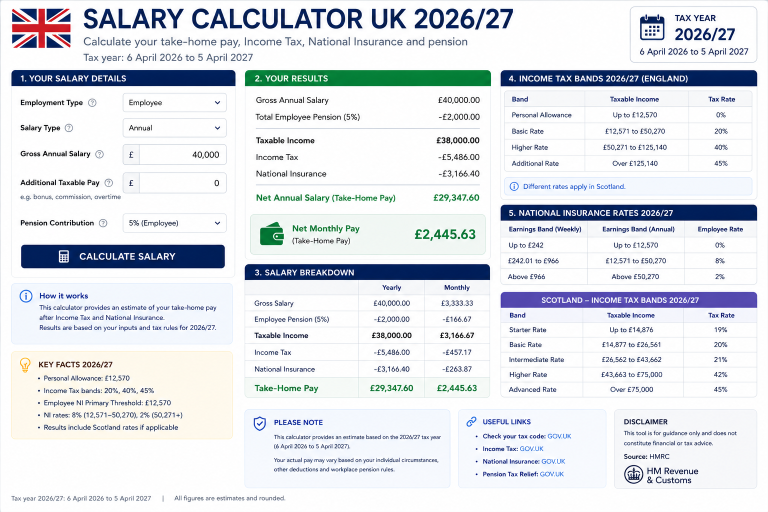
Take Home Pay Calculator UK 2026/27
Estimate annual, monthly, weekly and daily take-home pay from gross salary.Annual gross salaryRegionEngland / Wales / Northern IrelandScotland
Calculate
Result—
Result—
Result—
Result—
This Take Home Pay Calculator UK 2026/27 is tied to the 2026/27 tax year and models net-pay budgeting. It is deliberately an annual planning view: annual, monthly and weekly cash equivalents. A real payslip can still differ because payroll applies the employee’s tax code, pay frequency, cumulative history and any employer-specific deductions.
How to Use the Take Home Pay Calculator UK 2026/27
Take-home pay is cash after core statutory deductions, not the same thing as taxable income or total compensation. Take-home pay should be translated into the pay period the user budgets with. Annual, monthly and weekly averages are useful together because employment offers often quote one frequency while household bills use another.
This page uses annualised Income Tax and employee NI, then converts the resulting net figure into common pay periods. Irregular bonuses and payroll timing can make actual monthly bank payments uneven.
2026/27 Personal Allowance
Before applying rates on this page, the model considers the 2026/27 standard Personal Allowance of £12,570 where relevant. High earners need the taper: the allowance shrinks above £100,000 adjusted net income and is fully removed by £125,140. That rule can alter annual, monthly and weekly cash equivalents.
Income Tax Rates Used in the Model
Where this page needs the main UK non-savings rates, it uses the 2026/27 sequence of 20%, 40% and 45%. After allowances, the first £37,700 of taxable income sits in the basic band, with higher-rate income extending to £125,140 before the additional rate begins. On Take Home Pay Calculator UK 2026/27, this point is included because the calculator is specifically about cash take-home. The practical test is annual net converted into common budgeting periods; that keeps the explanation relevant to households planning monthly and weekly spending rather than turning it into a generic tax paragraph.
Where a regional comparison is useful for Take Home Pay Calculator UK 2026/27, Scotland is treated as a distinct employment-income system rather than a minor adjustment. Irregular bonuses, overtime and payroll-specific deductions can make actual month-to-month cash less even than the annual average shown here. Savings and dividend taxation are separate questions, so they are not folded into this salary comparison.
National Insurance and Other Deductions
Do not treat National Insurance as another Income Tax band. For pages involving employment cash pay, the model applies its own 2026/27 thresholds and the standard 8%/2% employee rates; for a page centred on net-pay budgeting, NI appears only if it changes the question being answered. In the context of Take Home Pay Calculator UK 2026/27, the number only matters when it changes cash take-home. This page therefore ties the rule back to annual net converted into common budgeting periods, which is the decision path most useful for households planning monthly and weekly spending.
If a user adds education-loan deductions to Take Home Pay Calculator UK 2026/27, the plan must be identified first. From April 2026 the annual thresholds range from £25,000 on Plan 5 to £33,795 on Plan 4; Plan 1 is £26,900, Plan 2 £29,385 and postgraduate £21,000. Undergraduate-style plans use 9%, postgraduate 6%. For this calculator, the next step is not to apply every tax rule on the site. It is to connect the figure with cash take-home, using annual net converted into common budgeting periods. That narrower scope is intentional for households planning monthly and weekly spending.
Who Should Use the Take Home Pay Calculator UK 2026/27
This calculator suits household budgeting because it converts the annual result into the pay frequencies people commonly use for rent, bills and savings targets.
The calculation centres on annual, monthly and weekly cash equivalents. Irregular bonuses, overtime and payroll-specific deductions can make actual month-to-month cash less even than the annual average shown here. Keeping those drivers explicit makes it possible to rerun the same scenario after a pay rise, code change or new tax year without guessing which assumption moved.
Use the result to understand net-pay budgeting, then move to a specialist page if another income source or deduction becomes material. A page that tries to solve salary, dividends, capital gains, benefits, pensions and multiple jobs in one default calculation would hide more assumptions than it explains.
Worked Examples for Take Home Pay Calculator UK 2026/27
- Example 1: enter £29,400 annual income and review the allowance, tax and any relevant payroll deduction separately. Changing only one input at a time makes it easier to see which threshold changes the result.
- Example 2: enter £36,400 annual income and review the allowance, tax and any relevant payroll deduction separately. Changing only one input at a time makes it easier to see which threshold changes the result.
- Example 3: enter £43,400 annual income and review the allowance, tax and any relevant payroll deduction separately. Changing only one input at a time makes it easier to see which threshold changes the result.
- Example 4: enter £50,400 annual income and review the allowance, tax and any relevant payroll deduction separately. Changing only one input at a time makes it easier to see which threshold changes the result.
- Example 5: enter £57,400 annual income and review the allowance, tax and any relevant payroll deduction separately. Changing only one input at a time makes it easier to see which threshold changes the result.
- Example 6: enter £64,400 annual income and review the allowance, tax and any relevant payroll deduction separately. Changing only one input at a time makes it easier to see which threshold changes the result.
- Example 7: enter £71,400 annual income and review the allowance, tax and any relevant payroll deduction separately. Changing only one input at a time makes it easier to see which threshold changes the result.
- Example 8: enter £78,400 annual income and review the allowance, tax and any relevant payroll deduction separately. Changing only one input at a time makes it easier to see which threshold changes the result.
Common Mistakes to Avoid
- Using 2025/26 thresholds on a page labelled 2026/27.
- Applying the highest marginal rate reached to the whole salary.
- Forgetting the Personal Allowance taper above £100,000 where it applies.
- Mixing Scottish employment-income rates with rest-of-UK bands.
- Treating National Insurance or student loans as if they were part of Income Tax.
- Assuming an annual estimate must equal every monthly PAYE deduction.
Related BritTaxCalc Calculators
Open the focused 2026/27 calculator.
Open the focused 2026/27 calculator.
Open the focused 2026/27 calculator.
Open the focused 2026/27 calculator.
Open the focused 2026/27 calculator.
Open the focused 2026/27 calculator.
Open the focused 2026/27 calculator.
Open the focused 2026/27 calculator.
Take Home Pay Calculator UK 2026/27 FAQs
What deductions are included by default?
Income Tax and category-A-style employee National Insurance are included in this core tool.Why is weekly pay an average?
The result divides annual net pay by 52; actual weekly payroll may differ because thresholds are applied per pay period.Which tax year is this calculator for?
The calculation is labelled for 6 April 2026 to 5 April 2027.Can actual payroll differ?
Yes. Pay frequency, cumulative PAYE, tax codes, benefits and other deductions can change a real payslip.