Salary Calculator UK 2026/27
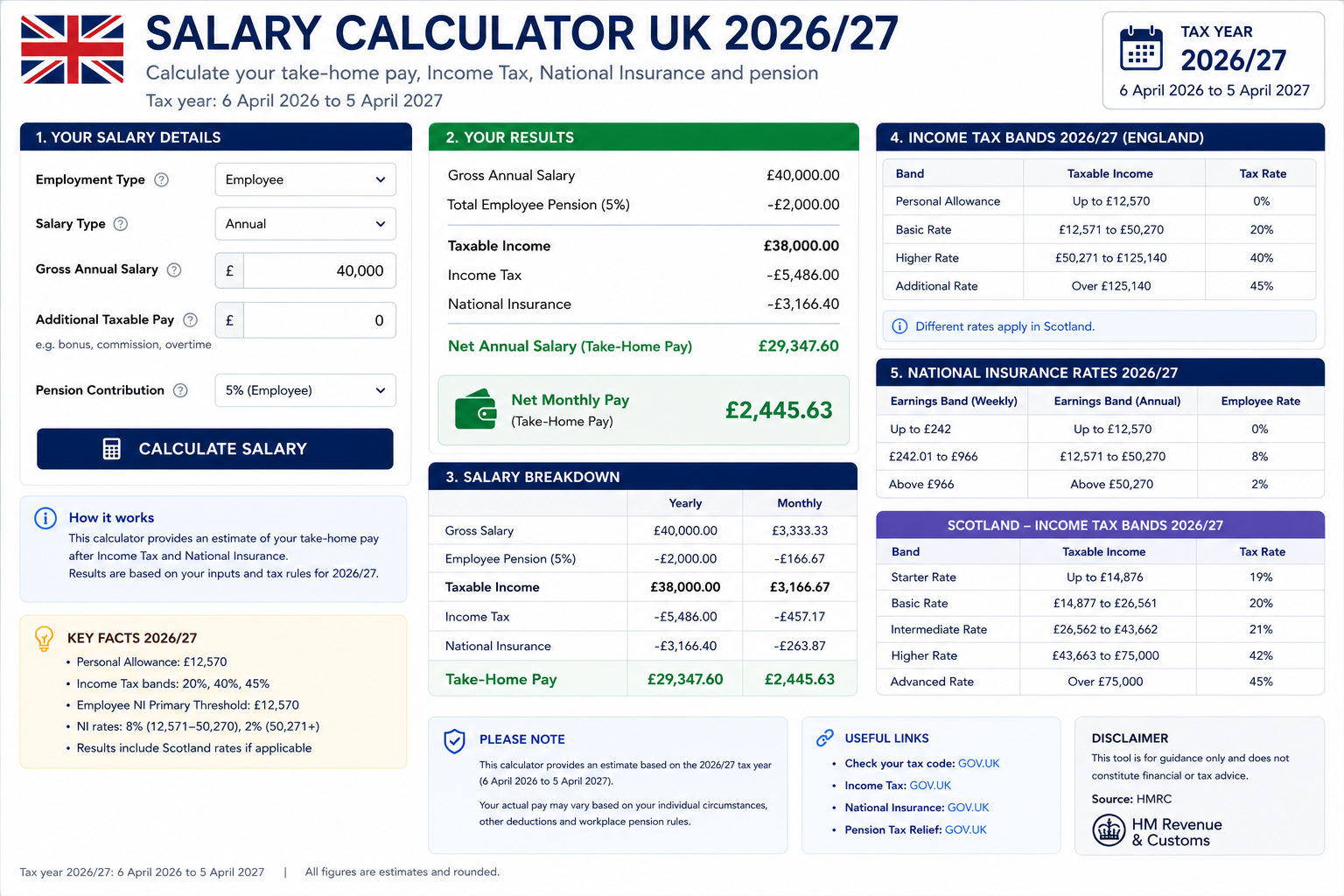
Turn annual gross salary into tax, National Insurance and net annual/monthly pay for 2026/27.Annual gross salaryRegionEngland / Wales / Northern IrelandScotland
Calculate
Result—
Result—
Result—
Result—
This page freezes its main assumptions to tax year 2026/27 so historic and future rates are not mixed. It focuses on gross-to-net salary conversion; Use this page for a first-pass job-offer calculation where the headline salary is known but the expected bank payment is not. The calculator therefore shows the inputs that matter most instead of inventing missing payroll details.
How to Use the Salary Calculator UK 2026/27
A salary comparison is most useful when every deduction is shown separately rather than hidden inside one net number. A salary page needs net pay as well as deductions. Showing annual and monthly outputs makes it useful for job offers while the separate tax and NI lines preserve transparency.
Choose the correct tax region before interpreting the result because Scottish employment income uses different bands. Use the specialist student-loan or pension tools when those deductions materially affect the offer.
2026/27 Personal Allowance
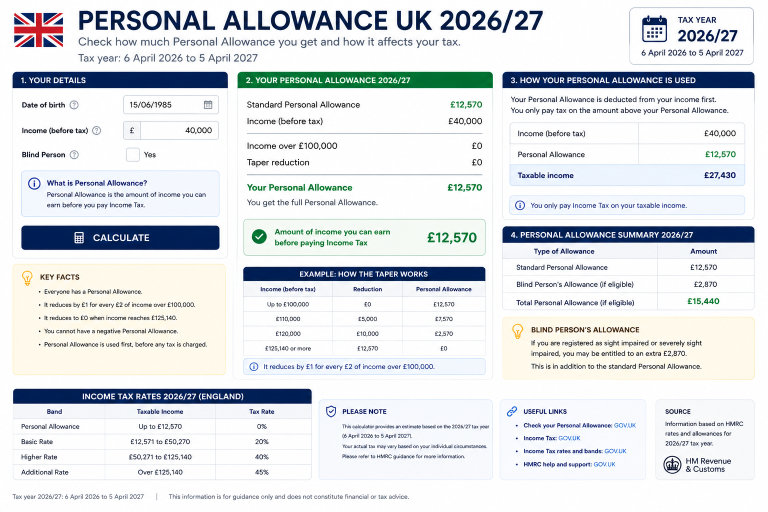
Personal Allowance matters to gross-to-net salary conversion because it determines how much income enters the tax bands. The standard 2026/27 amount is £12,570. Once adjusted net income exceeds £100,000, £1 of allowance is withdrawn for each £2 of excess income, leaving no standard allowance at £125,140. BritTaxCalc treats this differently on Salary Calculator UK 2026/27 because the core output is gross-to-net salary. By focusing on Income Tax plus employee National Insurance, the page avoids suggesting that the same rule has identical importance on every calculator.
Income Tax Rates Used in the Model
The England, Wales and Northern Ireland reference used here has a £37,700 taxable basic-rate band at 20%, followed by 40% up to £125,140 of taxable income and 45% beyond. This rate ladder is relevant to gross-to-net salary conversion when the user is not a Scottish taxpayer. On Salary Calculator UK 2026/27, this point is included because the calculator is specifically about gross-to-net salary. The practical test is Income Tax plus employee National Insurance; that keeps the explanation relevant to jobseekers comparing headline pay with bankable income rather than turning it into a generic tax paragraph.
Where a regional comparison is useful for Salary Calculator UK 2026/27, Scotland is treated as a distinct employment-income system rather than a minor adjustment. Region, salary level and any specialist deductions such as student loans or pension sacrifice are the inputs most likely to move net pay. Savings and dividend taxation are separate questions, so they are not folded into this salary comparison.
National Insurance and Other Deductions
The NI component is conditional on the purpose of the page. A salary or take-home calculation uses the standard 8% then 2% Class 1 employee pattern, while gross-to-net salary conversion may require no NI line at all. Keeping the components separate makes the result easier to audit.
Student-loan deductions sit outside Income Tax and use plan-specific 2026/27 thresholds: £26,900 for Plan 1, £29,385 for Plan 2, £33,795 for Plan 4, £25,000 for Plan 5 and £21,000 for postgraduate loans. The first four plans charge 9% above threshold, while postgraduate loans use 6%. In the context of Salary Calculator UK 2026/27, the number only matters when it changes gross-to-net salary. This page therefore ties the rule back to Income Tax plus employee National Insurance, which is the decision path most useful for jobseekers comparing headline pay with bankable income.
Who Should Use the Salary Calculator UK 2026/27
Use this page for a first-pass job-offer calculation where the headline salary is known but the expected bank payment is not.
The calculation centres on Income Tax, employee NI and net cash. Region, salary level and any specialist deductions such as student loans or pension sacrifice are the inputs most likely to move net pay. Keeping those drivers explicit makes it possible to rerun the same scenario after a pay rise, code change or new tax year without guessing which assumption moved.
Use the result to understand gross-to-net salary conversion, then move to a specialist page if another income source or deduction becomes material. A page that tries to solve salary, dividends, capital gains, benefits, pensions and multiple jobs in one default calculation would hide more assumptions than it explains.
Worked Examples for Salary Calculator UK 2026/27
- Example 1: enter £29,050 annual income and review the allowance, tax and any relevant payroll deduction separately. Changing only one input at a time makes it easier to see which threshold changes the result.
- Example 2: enter £36,050 annual income and review the allowance, tax and any relevant payroll deduction separately. Changing only one input at a time makes it easier to see which threshold changes the result.
- Example 3: enter £43,050 annual income and review the allowance, tax and any relevant payroll deduction separately. Changing only one input at a time makes it easier to see which threshold changes the result.
- Example 4: enter £50,050 annual income and review the allowance, tax and any relevant payroll deduction separately. Changing only one input at a time makes it easier to see which threshold changes the result.
- Example 5: enter £57,050 annual income and review the allowance, tax and any relevant payroll deduction separately. Changing only one input at a time makes it easier to see which threshold changes the result.
- Example 6: enter £64,050 annual income and review the allowance, tax and any relevant payroll deduction separately. Changing only one input at a time makes it easier to see which threshold changes the result.
- Example 7: enter £71,050 annual income and review the allowance, tax and any relevant payroll deduction separately. Changing only one input at a time makes it easier to see which threshold changes the result.
- Example 8: enter £78,050 annual income and review the allowance, tax and any relevant payroll deduction separately. Changing only one input at a time makes it easier to see which threshold changes the result.
Common Mistakes to Avoid
- Using 2025/26 thresholds on a page labelled 2026/27.
- Applying the highest marginal rate reached to the whole salary.
- Forgetting the Personal Allowance taper above £100,000 where it applies.
- Mixing Scottish employment-income rates with rest-of-UK bands.
- Treating National Insurance or student loans as if they were part of Income Tax.
- Assuming an annual estimate must equal every monthly PAYE deduction.
Related BritTaxCalc Calculators
Open the focused 2026/27 calculator.
Open the focused 2026/27 calculator.
Open the focused 2026/27 calculator.
Open the focused 2026/27 calculator.
Open the focused 2026/27 calculator.
Open the focused 2026/27 calculator.
Open the focused 2026/27 calculator.
Open the focused 2026/27 calculator.
Salary Calculator UK 2026/27 FAQs
Does salary include employer pension contributions?
No. The default calculation starts from gross cash salary and does not add employer pension value.Can I use it for Scotland?
Yes; choose Scotland to apply the separate Scottish non-savings income bands.Which tax year is this calculator for?
The calculation is labelled for 6 April 2026 to 5 April 2027.Can actual payroll differ?
Yes. Pay frequency, cumulative PAYE, tax codes, benefits and other deductions can change a real payslip.